Showing posts with label tools. Show all posts

Monday, April 2, 2012

944 Pre-season Work

It was a rainy weekend, and the 44 was at the body shop so lets tackle some of my pre-season tasks on my to-do list.

I was bored with my purple rain wheels. All the fashion magazines say that "Bold Colors" are in this spring, so lets see what we can do.

Matte purple - so last year ...

I'm a big tool fan. After a tedious 5 minutes of sanding the wheel and getting nowhere fast, I looked around the garage at the work ahead.

And that's only a portion of the phone dial collection


 I switched to using my #1 tool, my brain. Mr. Brain said if tools are good, power tools are even better. A hunt around the garage and I dug up my Dremel tool and set to work.

In progress

Yeah, that worked out


An hour later I was applying the first of several coats of my favorite go-to wheel paint, Rustoleum enamel with a foam brush. No fancy paint booth or spray system here, this is down home garage work here. It goes on reasonably thick, lays and settles well and ends up looking pretty good. It's pretty tough and durable also, standing up to brake dust. I wouldn't put this on a Ferrari GTO if I happened to own one, but for a racecar, good stuff.

White wheels? for racing? are you crazy? You don't even wash your racecar,
you just paint over the bugs. How are you going to keep these clean?


Meanwhile the 944 came back from the body shop, looking a little better than it went in. They fixed the crunched rear panel where Chris L and I came together in the Nationals. That was the only panel that hadn't been hit on the car. Almost made me cry when it happened. Charlie and the boys made the hood and fender flush. They also fixed the rear quarter, mudded it up and primed it. I declined the paint as I had about 20 cans of Rustolem Flat Black back in the garage.

Getting ready for  the pièce de résistance: Krylon Flat Black


The next item was to strip and clean the front suspension bits. I had some cool MantisRacing CNC'd strut hats and bar that I won a couple of years ago at Nationals. I ran into some fitment issues and while I'm sorting that out, I took apart the camber plates, strut hats, and sway bar assemblies. Cleaned all the grit and lubed them up and reassembled.

Mantissport strut hats and the Ground Control camber plate and my strut bar attachement


Next on the tick list, was replacing the hood pins. The goal was to make them a bit more fool (me) proof. Here's me at Lime Rock 2 years back.
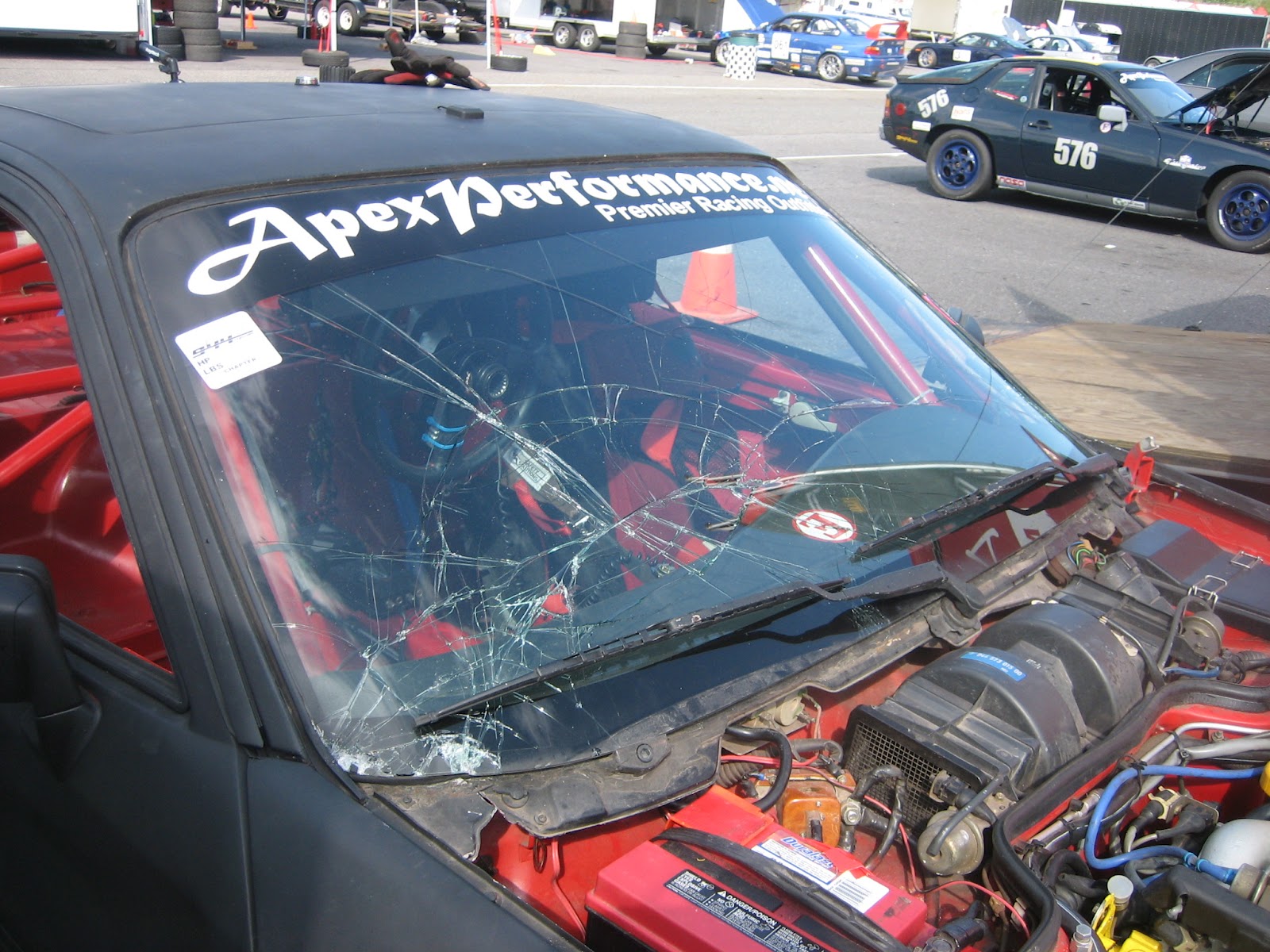
This is when the loose nut behind the wheel forgets the hood pins.


Here's the former setup


And the new flush mounted edition with internal pin.


Drivers side, easy peasy. Passenger not so much. Seems there was about 5 lbs of bondo on the corner of that hood and when I started drilling and sawing the hole, it started flaking off in huge lumps. If it's not one thing its another ...
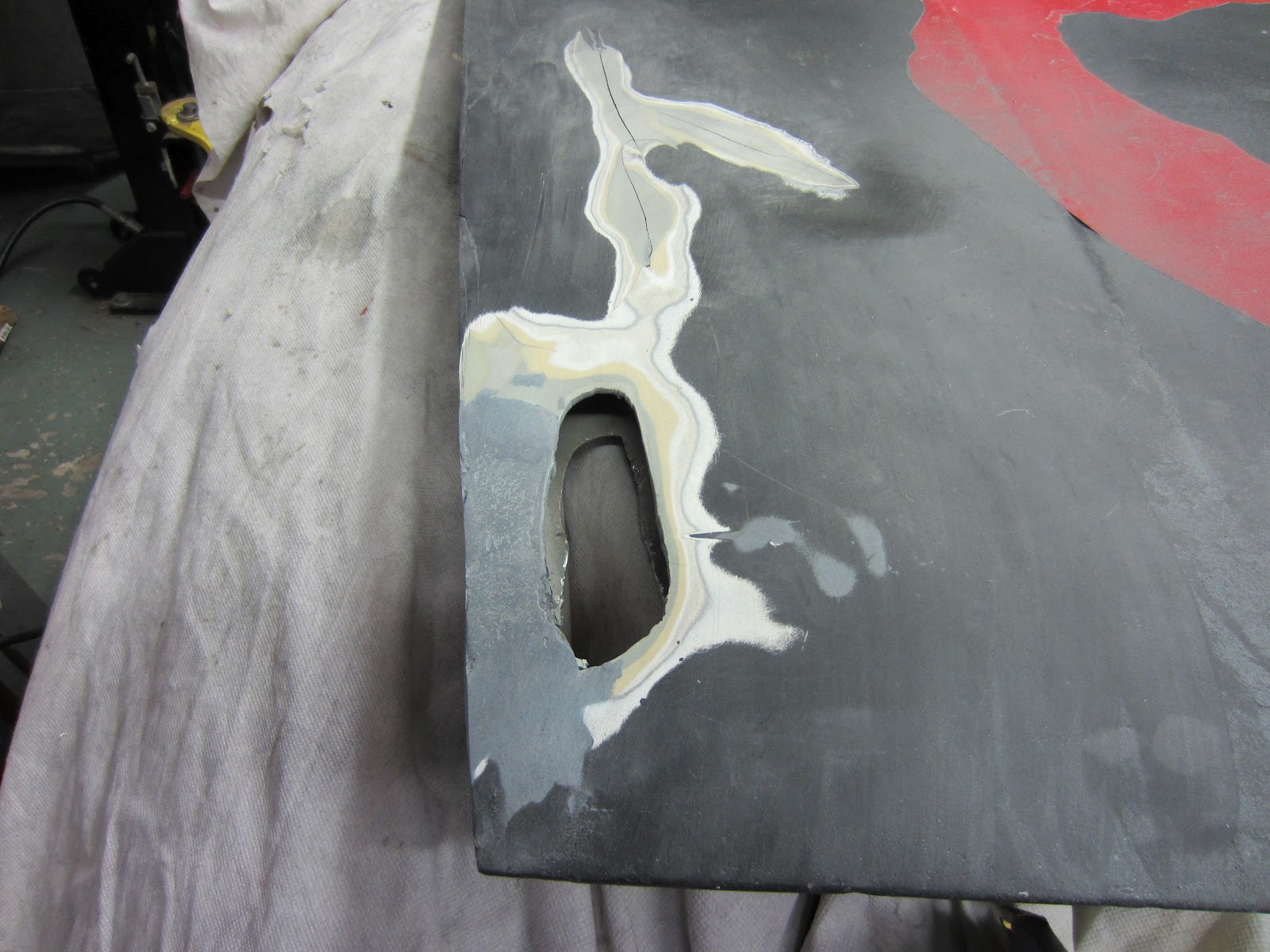
Putting the bondo universe back in balance.


And what started this whole post, oh yeah, the wheels. What is he going to do with them. Leave them white? Of course not. Remember Spring Fashion Tips? A pop of color? I'm painting them in the traditional Porsche color of Pink! Remember the Pink Pig? Here's my tribute.

Sunglasses not required. It will be raining when I'm running these.

Tools - an addedum

As readers know I'm a huge fan of tools. One of these things that these tools have in common beside solving problems, is the generation of large quantities of potential human altering actions or substances. Whether its the potential for cutting off a finger with my cutoff wheel - finally! says the tool, my dreams are realized - or being crushed under my lift, or more typically, flaying off my skin with the wire brush wheel in my grinder.

Lots of nasty bits flying around, ready to be inhaled or ingested, or inserted into some unsuspecting part of my anatomy.

So safety is a big concern. I have about 3 fire extinguishers in the shop. I wear a safety face shield when grinding on stuff, ear protectors when noisy tools are being fired, gloves and respirator while electroplating things. Double check the locks on my lift, etc.

But still, shit happens.

That's why I added something (safety) cool to the garage this week. An Eyewash station. This is for those times when you're crawling under the car, reaching up to fiddle with something, and blam, a rain of crap falls into your face and eyes. And while I don't want to lose a finger, I would have 9 left. I only have two eyes and I need them both to go racing.

So this is there, just in case. And a no-brainer for only $20.


Sunday, February 19, 2012

moto time


With the tranny now happy, it was time to working on the inline 4. I plan on cleaning and painting everything, replace most seals and gaskets, and do the rod bearings. As I get into it we'll see if anything else pops out.

Over the last couple of weeks I've been stripping the block of various bits and rehabbing and replacing those as I go. Now I'm down to just the main block. After cleaning, wire brushing and prepping, I applied a layer of Eastwood's ceramic motor paint to the main block. Since the car is at the body shop I can tell you that the color is actually Ford Blue, but you didn't hear that from me. And if you ask me when it's stuffed into the car I'll tell you it's an OEM BMW color. I swear officer!


I applied it with a foam brush and I'm happy with how it came out. It flowed very nicely and has a nice finish. Looks better than the silver I used on the 944 motors.

Once the main block was done, I moved on to more tasks. I pulled the rocker cover to take a look.


A closer view shows a little hottie, a Schrick 292 cam to help digest all that gas from the DCOE 45 Webers.


Started pulling the timing chain covers on the front of the motor. They'll be cleaned and repainted, and reattached with new gaskets.


Both covers now off. A friend of mine who works on American Iron remarked" "That's a long timing chain!". There's a 2nd chain on the pulley at the bottom going to the oil pump.


And of course, the timing covers headed over to the Alpine Garage's state of the art, paint booth.


But enough of that artsy cosmetic stuff, we want to see moto guts. Lets rip off the sump pan and get exposed.

Is that a con rod in your cylinder, or are you just happy to see me?


Luckily this is a 18 or older blog, as it's all in the open now.


New rod bearings - or as the British say, Big End Bearings - for the lady lump. Before moving on though, I first measured each bearing's clearance to make sure it was within spec. I used a tool called PlasticGage. A very thin wire made out of plastic. You put a small piece on the crank, add the bearing and torque to spec. This squishes the thin piece of plastic. Remove the con rod shell and bearing and then measure the width of the flattened plastic using the scale on the side of the PlasticGage. This tells you the bearing clearance. All rods were with spec.

You can see the green smushed line on the crank

And my favorite part of the weekend was torquing down the connecting rod bolts. Why you say?  Because I got to use my brand new Snap-on electronic torque wrench. What an awesome tool! Dialup the torque (in ft/lbs, newton/meters, etc) and have your way with that bolt. When you reach the spec, it vibrates in your hands and sounds an tone. It also tells you exactly what the final torque spec was. Too cool, it excited my inner tool geek. And just like when I got my first GPS and it told me exactly, when I wanted, how much further it was to my destination, you can watch the torque being applied in real time. Awesome! What can I say, I'm a cheap date ...

Tool porn

Saturday, January 21, 2012

Tools

I have a confession to make: I'm a tool user. And possibly a tool geek.


It's not something you would admit in public, like at a cocktail party, or at a PTA meeting. But if you're reading this, chances are you have the same "inclination".


So what is a tool? From Wikipedia we find: "A tool is a device that can be used to produce an item or achieve a task, but that is not consumed in the process. ...Tools are the most important items that the ancient humans used to climb to the top of the food chain; by inventing tools, they were able to accomplish tasks that human bodies could not, such as using a spear or bow and arrow to kill prey, since their teeth were not sharp enough to pierce many animals' skins.


I got to thinking about tools the other day when, due to the lack of a proper one, I was frustrated in "achieving my task". Luckily technology has advanced so that I generally don't need to create my own tools, I can just zip down to my local Harbor Freight or Sears Hardware and purchase one.


So big deal, everybody uses tools. A car is a tool that transports humans from one place to another. A bowl and spoon are tools for eating Grape-nuts in the morning. My racecar is a tool to (hopefully) win races or catch on fire. If you're human and alive, you're using tools. What slides this normal process toward the beginnings of geekness is the derivation of pleasure in viewing and most of all, in the use of a well designed tool. For most people, the tool is secondary to their task. Assembling an IKEA bookshelf they grab the cheap phillips screwdriver they keep in a drawer that they received when they bought 25 gallons of gas one day, or the pliers that came as a 14.99 auto repair kit Xmas gift. This often leads to an unsatisfactory experience, rounding the head of the screws, etc. 


But for a true tool geek, using a good tool is a sublime experience, that not only "achieves the task", but enhances it. A good tool typically is dedicated to one purpose. While a Leatherman multi-tool can be useful and functional in many situations, it's very nature compromises and dilutes the tool experience. I admit I own multi-tools, such as screwdrivers with multiple bits stored in the handles and the like. And they are useful in normal day to day activities. But when it comes to an important mechanical task, I also own several full sets of screwdrivers, each one dedicated to one particular task. The selection of the proper tool for a job, involves an endless set of factors, of which is outside of scope for this. But when the right tool is selected, and bought to bear on the problem, a well designed tool melds the user and the activity together. It's subtle, but definitely there. 


The Wiki article on tools got me to pondering the evolution of a another set of tools I have been using for many years, my ice axes. This is, after all, the "Alpine" Garage.


1970's ice axe technology


I started climbing back in the 70's. Just like everything else, technology was starting to touch this area of human activity. Unlike Rock climbing, where the tools (harness, rope, carabiners, chocks) are secondary, used for safety and backup only, in Ice climbing, tools are an essential component of the sport and play a huge role. As ice climbs become steeper, approaching and exceeding vertical, tools are necessary. No ice axes == staying on the ground. This focus on tools as part of the sport was one that attracted me.


In the picture above is state of the art technology for the 1970's. The bottom tool is a Mountain Technology ice axe from Scotland. This is a general purpose tool, patterned on the same technology all the way back to the 1800's. Edward Whymper climbing the Matterhorn in 1865 would have immediately recognized it. But even here we are seeing stirrings of technology creeping in. The tool is much shorter than a typical ice axe, allowing it to be swung above the head like a hammer, allowing steeper terrain to be attacked. The shaft is no longer wood, but metal, and coated with rubber, affording a better grip.


The top tool is a Lowe Hummingbird hammer. One side is a hammer head for banging in screws to vertical ice. The other side carries a drooping pick for lodging into the ice. Compare the tool to the Mountain Tech below. It's shorter more compact, no spike in the bottom handle, the pick is straight and sharply angled down. This is a specialist tool, useless for tromping along a glacier, but superb for attacking frozen waterfalls.


While the Hummingbird is relegated to the back of the closet, the Mountain Tech axe is a timeless design, like a good vintage car, and is still brought out to occasionally play in the mountains. 


The Reagan era, the 1980's 

Here's my tools from the 1980's, a pair of Chouinard X ice axes. Technology is fully in play here now. Both axes are much shorter, thus becoming less useful in general mountaineering, only useful on nearly vertical terrain. The heads are forged, not cast and feature a locking system for mounting different picks depending on the ice conditions. The shafts are hollow steel and lighter. The leashes are designed to lock the hands on the shafts giving better grip, but also release to slide up the shaft for flexibility. These were good designed tools that I used successfully for many years. 


The Internet arrives, the 1990's


Now we move into the realm of totally specialist tools. These are Charlet Moser Quasars, the hot tool of the 90's. The first time I swung these tools into steep ice I was in love. The perfect example of all the components for human/tool unity. Light weight to reduce fatigue, but still heavy enough in the head to penetrate the ice. Notice the curved shaft which allowed full swings over edges without bashing your knuckles, a common occurrence on straight shafted tools. The head was fully modular to accept different picks, hammer heads, aze heads and the like. Grippy rubber at the bottom of the tool with a slight bump to settle the little finger of your hand on. They were a delight to use. After a few whacks into the ice, they disappeared as separate objects and became extensions of my body, manifestations of my desire to ascend upward. No greater compliment can be given to a tool than to become so invisible that they become expressions of your will.


My tool of choice today - Black Diamond Cobras


While the Quasars were the perfect tool for me and great technology, ice climbing is a sport, and just as the tools evolved, the sport itself evolved. As the tools got better, the challenges became diminished. Feats that were impossible years ago, become commonplace. Once the limit was a 50 degree snow slope, today vertical and even overhanging ice is considered routine and accessible by any reasonably fit athlete. Up until the mid 2000's, climbing ice meant attaching yourself to your tools with some sort of leash. The leashes were used to hang from your tools so you didn't have depend on having death grip on the handle. Often during a ice climb you needed to remove your hands from the leash to place ice screws and other protection, so elaborate locking and caming systems were devised for the leashes. One day somebody thought, Why don't we just get rid of the leashes? 


And so a new chapter was born in the sport. My current tools, the BD Cobras, are very similar to my Quasars, but adapted for the new world of leashless climbing. When you have a good tool design, stick with it. Once again this is a highly focused, specialized tool design. Crafted with carbon fiber shaft and forged heads, they are immediately recognizable by a tool geek. Even if you have no desire to set a pick into a frozen waterfall, the visual appeal, the craftmanship, the purposefulness, the feel as you pick up the tool, all bring a smile to a discerning tool user. And that's another mark of well crafted tool, the purity of its design will come through.


Saturday, June 11, 2011

Can't a girl get some privacy?

So I'm under the parts car, unbolting this, unscrewing that, in preparation for dropping the motor. Since this isn't a repair, but a removal I'm just cutting the old a/c and power steering belts to get them out of the way. So I have a wrench on a bound up bolt on the power steering assembly and I shift my position towards over to the left side, backing up against the driver's side tire to get some leverage. I can see the A/C belt dangling in my peripheral vision as I'm applying pressure on the wrench.

Loose belts or something more sinister?

All of a sudden, the A/C belt starts wiggling. WTF? I'm distracted, concentrating on my bolt removal job, don't want to smash my knuckles when it lets go. Next I hear "hissssssssss......ssssssss". What? I turn my head and 6 inches away, staring right at me is a 10 foot long black pit viper of death! Holy shit! I jerk back, smacking my head of course and scramble from underneath the car.

After a few seconds I reconsider my original impressions. It might not be a black viper of death, or even 10 feet long. But it definitely is a snake and not an a/c belt.

In theory, I'm a fan of snakes. They eat lots of bugs, and small varmints and provide amusement for my huskies in the yard. That said, I don't know any snakes on a first name basis. So I went to the kitchen for my bar-q-que grill tongs and removed Ms. Snake from where she was coiled up in the brake rotor. It wasn't a happy removal, she questioned my ancestry and my mechanic skills, but I persevered. I released her in the driveway and pointed her toward the bushes where I'm sure she will be lurking in the future.

Afterwards I realized why she was so upset. Rude person that I am, I had barged into her dressing room. She was changing into her new summer clothes. My bad.

My (Premature) Obiturary

Lots of news organizations maintain pre-written obits so that when a celebrity passes, they open up the file and need to just update a few l...